
As the first hire (or first marketing hire) at multiple early-stage startups, I established and built from scratch:
- ICP and market understanding
- Product positioning and messaging
- Marketing channels
- Conversion funnels
- Go-to-market motions
- Attribution
- CAC and payback management
- Lifecycle marketing motions
- Teams (marketing teams directly, and supporting sales, product, and CS teams)
The throughline that connects this work is an approach to acquiring customers and growing revenue:
- Understand the problem your product solves and for whom
- Talk to those people to learn how they describe their problem and what they’re looking for
- Learn where they’re looking for solutions, or what would make them consider looking for a solution
- Use what you learned from step 2 and 3 to test positioning and messaging in different channels
- Measure the performance
I know that this is the work I enjoy doing, and while I always called it “early-stage startup marketing”, I believe it’s also the work of a product marketer.
What does a product marketer do?
A product marketer deeply understands a product and the problem it solves for a specific group of people, and translates that understanding to positioning, messaging, and channel experiments.
They have answers to fundamental questions like:
- How do they solve the problem without our product today?
- In what ways are those solutions insufficient?
- How is our product better than competing solutions?
- What happens when the problem becomes sufficiently painful and they start looking for a new solution?
- Where do they go to find a new solution?
- Or, if they rarely are actively searching for a solution, what would they have to believe about a new product to convince them to try it?
- How do we need to describe the product to persuade them to try it?
- How do they want to learn about/try the product before they buy it?
- How much are they willing to pay?
The process of getting the answers to these questions is “The Work” of a product marketer.
It runs in a cycle that looks like this:
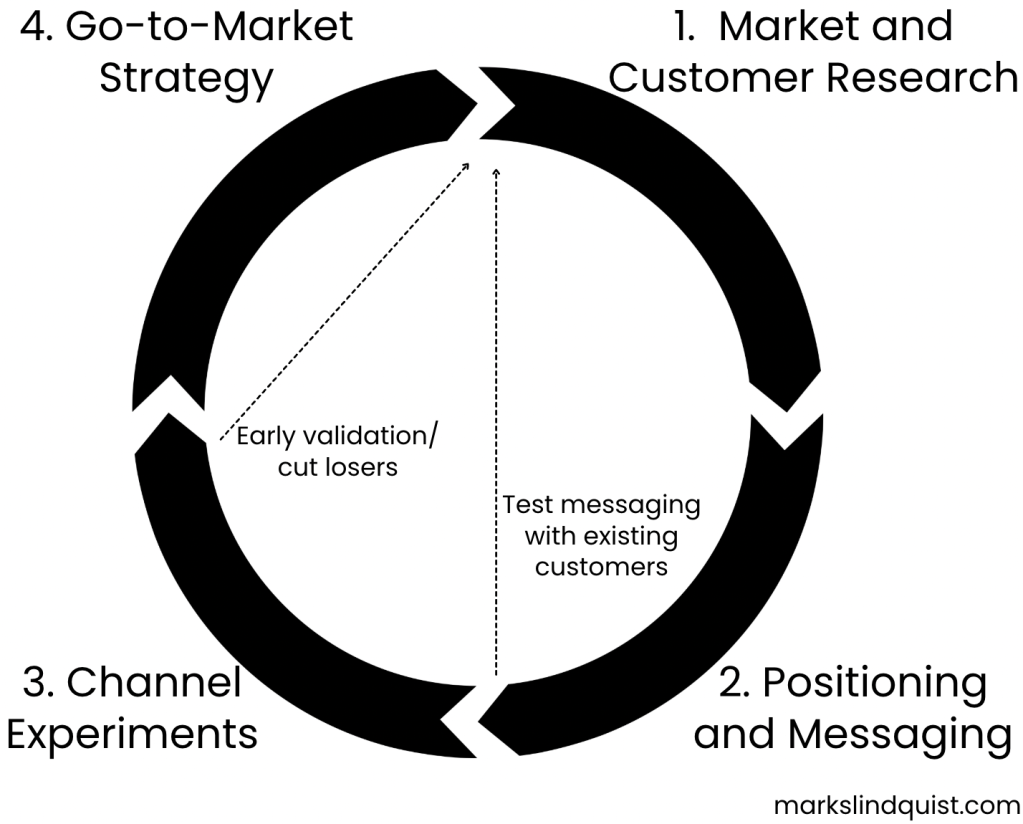
Customer understanding turns into positioning and messaging turns into channel experiments turns into go-to-market strategy.
You learn more about your market and customer while you’re executing each step, which gives you more data that you use to sharpen your positioning and messaging and improve your channel experiments.
My Product Marketing Experience
Below, I break down those steps a little more and connect them to my experience in my last two roles at Community Phone and Mailshake.
Market Analysis
Step 1 of the product marketing process is understanding your market, competitive landscape, and ICPs.
Market/Competitor research
At Community Phone, I reviewed dozens of competitors, direct and indirect, to understand their pricing, positioning, buying journey, and marketing strategy. I identified a gap in the market in between low-priced internet-based VoIP providers, and high-priced copper wire traditional landline providers. These insights were the backbone of the positioning and messaging that unlocked paid and organic search channels.
At Mailshake, I manually reviewed all our competitors in the sales automation space and created blog articles to capture SEO traffic for folks searching for alternatives (like this one). I also scraped the profiles of folks who reviewed us and our competitors on G2, and matched them to their personal and company LinkedIn profiles to learn how our competitor’s ICPs compared to ours.
Customer research
At Community Phone, I talked with thousands of leads and customers over the phone and via email, and closed over 100 consumers and businesses myself. I listened to sales and customer service calls, and talked constantly with sales and CS frontline reps to understand why they were losing deals and why customers were churning. This work shaped the positioning and product strategy, conversion journey, and post-sale onboarding I built and supported.
At Mailshake, I personally reviewed hundreds of customer accounts to learn how they were using the tool, and to evaluate the quality of their outreach. I also handled customer support in the early days before training our first CS reps. Through this process, I learned that our customers were not seeing results with our product because they didn’t have a strong cold email strategy, which explained much of our churn. These insights led us to build an in-house high-touch customer success team, which remains one of Mailshake’s primary differentiators in a crowded space.
Product positioning and messaging
Market and customer insights provide qualitative and quantitative data that a product marketer uses to inform positioning and messaging ideas.
At Community Phone, the market was split between people who:
- Were ok with less reliable internet-based VoIP home phone service providers that were cheap and widely available
- Wanted more reliable copper wire landline service from “the phone company” that was expensive (4x to 8x the price of VoIP) and not available in many parts of the country
My insight was that Community Phone sat in the middle of these two options:
- It was more reliable than internet-based VoIP, because it connects a landline phone to cell towers instead of working off the internet
- It was cheaper than copper wire landline service, and available anywhere in the country
This translated to the “landline phone service that doesn’t require internet” messaging that unlocked the search marketing strategy that took us from $500k to $8M ARR.
At Mailshake, our primary customers were early-stage entrepreneurs, freelancers, and agency owners, where the decision-maker for the product was typically also the end-user. They didn’t need bells and whistles – they just wanted software that was easy to use, where they could set up a campaign and generate leads without having to manage it.
The messaging we chose was “put your email outreach on autopilot” and the copy focused on reviews highlighting how easy it is to use. This messaging was the foundation of our growth from $1M to $5M ARR.
Go-to-Market Strategy
Finding channel-market fit requires learning how to serve the demand you’re generating. You may have the right message, and you may even have the right channel, but if you’re not providing your leads with the buying experience they expect, your CAC will remain high and you’ll abandon channels prematurely.
Channel development
This section could not scratch the surface of the work required for standing up a channel from 0-to-1, but it provides some context to explain the go-to-market strategy development work.
At Community Phone, the first channels I stood up were paid search and organic search. Once we locked in the landline service positioning, the true unlock came from optimizing the conversion funnel and building the inbound sales team to serve the demand.
At Mailshake, I stood up SEO-led content marketing, which was our primary acquisition channel. However, the goal was to reach $100M ARR, and we chose this channel before we deeply understood the ICP that was capable of delivering that goal.
SEO allowed us to bootstrap the business to profitability, but it attracted a low-LTV, high-churn customer (early-stage startup founders, freelancers, and agency owners). To grow at the rate the business demanded, we had to build different channels that got in front of sales leaders of mid-size SaaS businesses and acquired whole sales teams.
My experience at Mailshake was an important lesson that “some revenue growth” and “seemingly qualified organic traffic” could pull you down a path that doesn’t ultimately align with the long-term business goals. You have to really understand the customer you want to acquire in order to build product and marketing that acquires them.
Funnel development
At Community Phone, I learned through talking to customers and reviewing the buying journeys for competing products that people expected to enter their address and confirm we had coverage at their address.
I launched an experiment where the primary CTA on our landing page asked visitors to enter their address, and the conversion rate spiked. We learned that it met their buying expectations and built trust that our solution would work for them. We also were able to retarget them offline with direct mail, which had a conversion rate near 1% and was our most efficient MOFU channel.
Two significant challenges in selling home phone service stemmed from the fact that our buyers were typically seniors or elderly folks. That meant they were:
- Generally less comfortable purchasing products online
- Especially uncomfortable purchasing home phone service and transferring their phone number without talking to real person
In reviewing website session recordings, exchanging emails with customers, talking to them myself, and listening to sales calls, I learned that there was a strong preference on the part of our ICP to purchase the service over the phone with a representative, rather than signing up online.
For that reason, I spearheaded the development of an inbound call center team that was specifically trained to sell over the phone. I hired the early reps and sales managers, and built the CRM and call center tools the team used to make and receive calls.
This inbound call sales motion allowed us to offer a buying experience the market demanded but couldn’t get from low-cost competitors, and separated us in the market as we grew to $10M ARR. It remains the sales motion for the business today.
Pricing
At Mailshake, we raised prices from $19/mo to $49/mo in $10 increments over the course of 8 months. Each time, our revenue grew faster. We also raised prices on existing customers, which provided a jolt of additional growth as well. I expected conversion rates to plummet and churn to skyrocket, but they never did.
At Community Phone, we raised prices from $19/mo to $39/mo in $10 increments over the course of 3 months, and . For a consumer product relying on performance marketing channels, we did see conversion rates fall when we increased from $29/mo to $39/mo, but the additional $10 gross margin and the reduction in customer support burden more than made up for it.
Later, we were running low on inventory, and raised prices to $49/mo. Conversion rates fell significantly, and we believe this natural experiment told us that $39/mo was the highest the market would bear.
I learned the same lesson at Community Phone and Mailshake – most businesses aren’t charging enough, and one of the fastest levers of quick growth is to raise prices.
I also learned that you can do your best to choose the right pricing, but the only way to know if it’s the right price is to launch it and monitor the conversion rate on mature channels before and after.
Measurement
A huge part of my job at Community Phone was building the attribution infrastructure. This was a challenge because 90%+ of sales happened over-the-phone (so we couldn’t just put a tracking pixel on a post-purchase thank you page), and there was no CRM (so there was way to know if a call turned into a sale).
I set up the early sales team with CallRail to track the source, medium, and click IDs of all sales calls we received. As the sales team grew, I built our CRM from scratch with Close and connected CallRail tracking, which allowed me to track by channel:
- Lead volume
- Revenue
- Churn rate
- Fully-loaded CAC – channel spend + amortized cost of sales, customer support, and software
- LTV
- Payback period
I hired a rev ops leader and worked closely with him to build a more automated and professional version of our CRM and attribution in Hubspot and SQL. This real-time attribution system was one of the most important documents in the business, and was a driving force behind all our growth and product decisions.
Retention
I worked closely with the product and customer success team at Community Phone to figure out why customers were churning and what we could do to prevent it.
At times, churn reduction was my primary focus; I wrote onboarding emails, hired teams to proactively reach out to customers to help them get set up, made videos showing how to set up the product, helped write scripts for sales to make sure we qualified customers properly and for CS to diagnose issues, and everything in between.
Over time, we learned that we were acquiring too many customers who weren’t getting enough value from the product to keep paying for it. Short of changing the core product, no amount of churn reduction work would move the needle as much as we needed.
The lesson I learned was that churn reduction tactics have a local maximum, and a better use of time is to acquire more of your best-fit customers – the ones who really need your product. This creates a virtuous cycle; your reviews and word-of-mouth are stronger, you optimize your algorithmic channels towards them, and you build your product to serve them instead of the market that only kind of needs your product.
Looking back at my time at Mailshake and the lesson is even clearer. Our primary user was not an experienced salesperson, and was usually “taking a flyer” on trying cold email. Without a strong strategy, they were not going to generate leads, and would churn regardless of which cold email automation tool they used. The only way to reduce churn at Mailshake was to acquire a different type of user.
Product launches
At Community Phone, we recognized that a significant problem our customers had with their home phone service was the number of spam calls they received.
To validate if there was demand for a spam call blocking product, I looked at publicly available information like search volume and looked at competitor products that offered spam call blocking to see how much they foregrounded it in their messaging.
I personally talked to customers, and found that folks buying for elderly loved ones were particularly sensitive to this problem. They also were less price-sensitive than end users, and could afford a premium add-on.
Finally, I created a landing page to join a waitlist that I drove traffic to from relevant blog articles to demonstrate there was a market.
When we decided the product had enough demand to launch it to the market, we started by building excitement with the frontline sales and customer service reps by making it clear how it would make their lives better. For customer service, spam call blocking meant fewer angry customers and opportunities for them to earn bonuses for upsales. For sales, it meant a more valuable product and an easier path to hitting quota.
We added spam call blocking prominently to our main landing pages through a number of CRO experiments, but were not able to increase the conversion rate. In fact, the conversion rate actually fell when we foregrounded spam call blocking.
In talking to customers, listening to calls, and working closely with specific sales reps, I learned that spam call blocking was not a feature that was strong enough to bring people into market or differentiate us for people who really just wanted regular landline service. Spam call blocking was a nice-to-have, but an order of magnitude less important than the quality of the phone service itself.
Through working with the sales team further, we demonstrated that the opportunity was in the upsell; after we had closed someone, we could close an additional 20% – 30% on spam call blocking for an additional $10/month.
With this insight, we made spam call blocking upsells a part of the sales scripts, post-sale email and physical mail follow-ups, and added the option to add spam call blocking to their portal.
Spam call blocking added $3 to our average net MRR, generating an additional $500k of ARR and $400k gross profit per year.

 My career story and thoughts on startup marketing strategy