
Building links is still critical to an SEO strategy, and I believe it will be for a long-enough period that it’s worth figuring out how to do it at scale.
Links are an imperfect and easily gamed proxy metric that Google uses to inform their algorithms if a piece of content is good. That’s why I think there’s no doubt that eventually, Google’s AI will get good-enough at understanding content quality and search intent that it won’t need to use backlinks as a signal.
But that day is not today, or this year. It also won’t happen over night; as long as you’re actually creating good, useful content, and are committed to weathering the stormy seas of algorithm updates, you can keep playing Google’s game and pivot your strategy as links become less relevant.
I have only seen 4 linkbuilding methods actually work at scale:
- Find a scalable and highly attractive “offer” you can make to link targets
- Build relationships with editors and content creators in your industry
- Create compelling original data or stories to generate PR mentions
- Pay an agency or consultant with relationships in or adjacent to your industry
#3 is hard, because you have to bring the substance – genuinely original data about a topic that a journalist’s readers care about right now.
#4 works and when done right, is a cost-effective way to supplement your in-house linkbuilding efforts, but requires its own article on how to vet content and SEO agencies.
In this article, I’ll focus on how to do 1 and 2, with examples of how I’ve done it in the past. The ideas are simple but they take creativity, grit, and talent to execute and scale.
The premise of these tactics are:
- Nobody will do anything for anyone unless the benefit to them is obvious and easy
- Many people will do low-effort favors for people they know and trust
Why Traditional Linkbuilding Tactics Don’t Work
There is a long list of mostly dead linkbuilding tactics that stopped working because they were based on asking strangers to do something without receiving anything of value in return.
For example, a popular old-fashioned linkbuilding tactic was called the “skyscraper technique”*. You would find a piece of content that has a ton of links, and create something that’s 10x better, then reach out to everyone who linked to the original piece to share your new piece and ask them to swap the link.
The main problem with this technique is that it assumes that editors care if a page they link to in an article is the best possible resource on that topic. Usually, this is not the case.
First, think about your own blog – how much do you care about the pages you link to? I bet you haven’t really thought about (which is signal in and of itself), and beyond a general sense of not wanting to link to scammy websites, I bet you don’t really care.
Second, take a look at the analytics on your most popular blog post. What percentage of that traffic is clicking on any particular external link in that article? Probably less than 1%… maybe closer to 0.1%.
You’re busy; are you really going to review the piece they created, then go into your CMS and change the link to serve the smallest percentage of mostly unqualified blog traffic?
This all is assuming the can opener, too – that the piece actually is “10x better”. This is a technique created by marketers, for marketers. It’s unlikely the piece is even good at all, much less “10x better” than what’s out there.
The bottom line is that traditional linkbuilding makes the incorrect assumption that people will do something valuable for you that provides them with little to no value.
Effective linkbuilding deals with the reality that you have to make strangers “an offer they can’t refuse” to get them to get off the couch and do something for you.
*I chose the skyscraper techinque to steel man the criticism – I think the skyscraper technique is the best tactic from a list of tactics like broken linkbuilding, guestographics, adding helpful content to existing articles, etc. Here is the original article from Brian Dean which has been linked to by over 1,500 different websites.
Find a scalable and highly attractive “offer” you can make to link targets
When you don’t have a brand or pre-existing relationships, the best way to start a linkbuilding campaign from scratch is to design an offer that is simple, clear, and so attractive that it’s a no-brainer for your link target.
To run this process, you need to find a content topic area that’s at least close to your business’ niche, and has lots of websites creating content about it. That will mean the links you build we be from relevant domains, and there will be enough targets to move the needle for your domain authority.
Next, you have to find the people at these websites who control their blog. Sometimes that’s a content strategist or editor, but often it’s the marketing leader or co-founder/CEO.
Once you have your list of outreach targets, you need to figure out how to give them something that a) they perceive as valuable, and b) is easy for you to deliver.
Finally, once you have your foot in the door, you have to be clear and direct about your intention to work with them to get a link placed on their site.
I’ll illustrate this through two examples of strategies I used for a recent clint, and from my time at Mailshake.
Feature positions on high-value pages
A client I am working with offers services for patients interested in psychedelic therapy.
The challenge in this industry is that most of the websites creating content about this topic are:
- Medical journals
- Massive sites like Healthline or WebMD
- The clinics providing the therapy
The first two are non-starters; they don’t do linkbuilding the same way we do and they wouldn’t respond to cold outreach.
We had a shot at working with the clinics, but typically don’t have a marketing person who owns even a basic content marketing motion. That means you’re usually reaching out to generic “info@” email addresses and connecting with the primary physician and founder of the clinic. Not exactly the eager marketing person I had at Mailshake.
This client had built up a directory of clinics, organized by state and city, with the goal of ranking for “Top {{therapy}} providers in {{city}}”.
While it didn’t rank for those terms, it did rank for very specific, zero-volume but seemingly high-intent searches like “{{therapy}} clinics in {{city}}”.
I reached out to every clinic offering to move them to the top of the directory and write an in-depth feature about their clinic in exchange for a blog post written by the co-founder (who is a medical doctor).
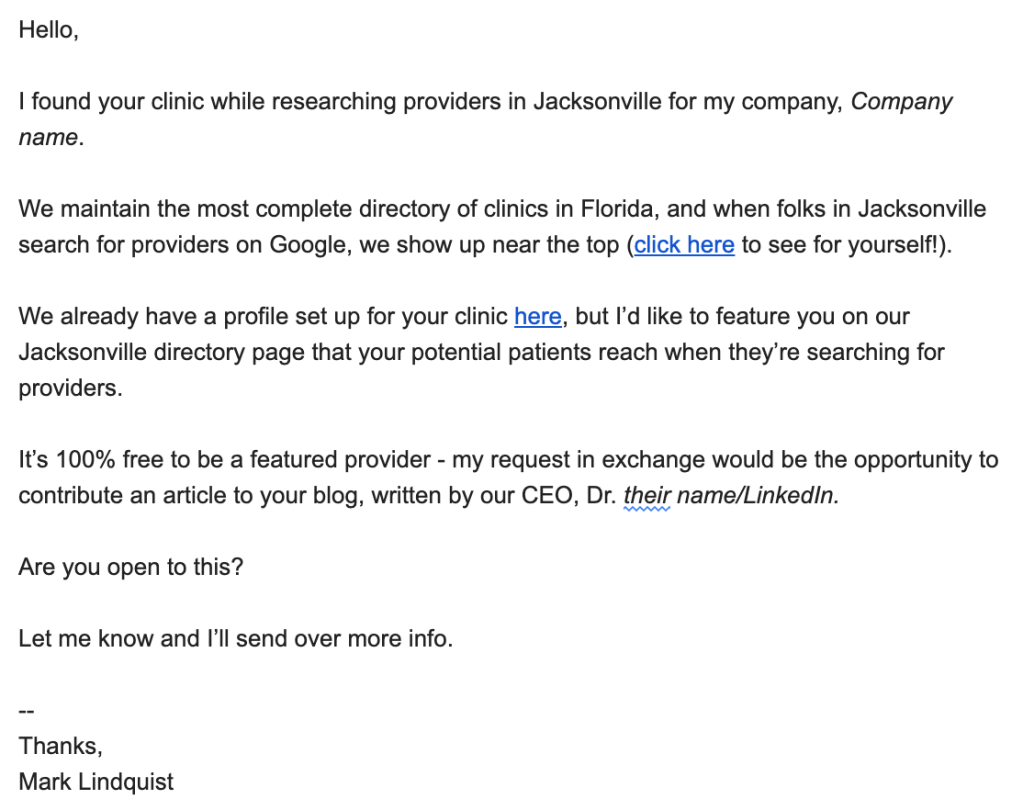
The feature content was templated – we listed information like what conditions they treat, how long they’ve been operating, how much their services cost, etc. I also scraped their Google reviews and had ChatGPT summarize them to fill it out with more substance.
Once I published the feature, I wrote the guest post using ChatGPT, and the co-founder reviewed it to make sure it was accurate.
The result was that we placed guest posts with links to the relevant city/state page on the blogs of about 25% of the clinics we reached out to. Once we figured out the angle and the process, each link took less than an hour of work all-in.
Ego Bait Listicles
Mailshake is sales automation software, which is a crowded content space (think sales tech and martech). Because the industry is a red ocean with low startup costs and a wide range of use cases, companies have big marketing teams full of B-players, and they are desperate.
Enter the ego bait listicle – Top 15 CRM Software for Salespeople. This is one of many articles we wrote for every industry that created content for salespeople, marketers, and entrepreneurs.
We would choose the recommended tools based on which companies:
- Had active blogs, so they had assets we could leverage for links
- Actually responded to our outreach
To find the person at these companies who managed the blog, I would run a Google site search of LinkedIn of the company and a generic term like “content” or “marketer”.
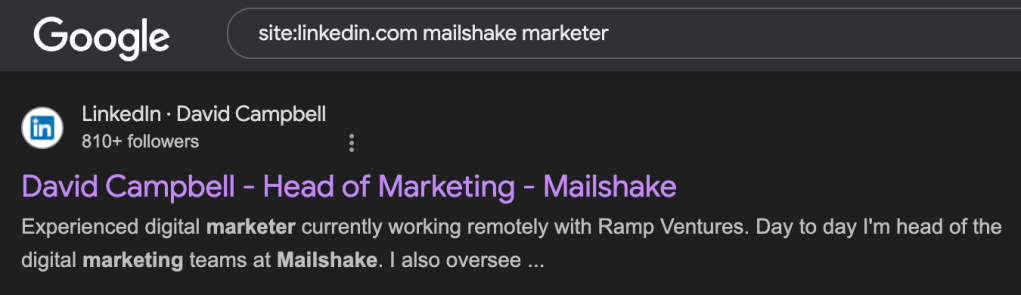
To find their email, I would use Hunter and Voila Norbert, but there are many cheap/free options out there once you have a name and domain.
With my outreach target set, I would send them a series of cold emails saying that “we wanted to feature them” and included the actual write-up we intended to publish, along with their prices.
The offer was that they could rewrite their section, correct the pricing, and make an exclusive offer to readers, like “follow this link and get a 30 day free instead of 15” (this is not on the article anymore).
The result was that about 40% of the tools we reached out to were thrilled to be featured, eagerly sent us copy and offers for the piece, and shared it on their socials once it was published (which is useless, but indicates their excitement).
Now we’ve given them something they perceive as valuable – a feature on a best of listicle – that only required about 15 minutes of work on their end.
Once the article was published, we demonstrated we could deliver something of quality, and we had our foot in the door to work with the person who owned their content and would be our partner to build links in the future.
The good will we built through this process turned into a network of editors and content creators, which we parlayed into easy guest posts, link placements, and 3-way link trades.
Build relationships with editors and content creators in your industry
Once you’ve established a relationship with content folks in your industry, the linkbuilding process becomes much easier.
This is the dirty little secret of SEO and content marketing; linkbuilding agencies and high-volume in-house linkbuilding teams are just leaning on pre-existing relationships with editors who will add links to their existing content, or accept a guest post, as long as it’s of decent quality.
There are many ways to build relationships with folks in your industry. A scalable method is the one I described above; cold outreach with an attractive offer.
Another method is email them and just express excitement about the quality of their work, and see if they’re open to jumping on a 30-minute call to talk shop as colleagues in the industry. Steer the conversation towards a content partnership and take it from there.
However you do it, make this an ongoing project, and dedicate a few hours/week to connecting with folks you can work with.
The best way to cultivate and grow these relationships is to continue to provide them value. And in my experience, the best way to provide ongoing value to lots of link partners at the same time is with the 3-way link trade.
3-way link trade
Eventually, through this process of building relationships, you’ll connect with someone at a place with a recognizable brand. At Mailshake, we started working with content folks at Hubpsot, and were able to submit guest posts to publish on their blog.
We would choose a topic that was generic-enough that we could cover a lot of ground in the article. Then, we would reach out to all our link partners and ask them for a quote. We would work their quote into the article and include a link, in exchange for them updating an existing article of theirs to link to us.
We scaled this heavily. We’d write at least one article/month for Hubspot, and more for other smaller blogs, and build 50+ links/month, paying only for the cost of our freelancer writer and our time performing the outreach.
And best of all, because the links were so valuable, we could get links on their highest authority pages to just about any page we wanted on our site.
3-way linkbuilding combines relationships with the attractive offer. It formed the foundation of the linkbuilding strategy at Mailshake, and was the driving force behind growing organic traffic to nearly 250k/month.

 My career story and thoughts on startup marketing strategy